By Lijuan Huang
In Nanjing, I Learned to Listen to the Pulse Differently
Lijuan Huang’s Chinese medicine notebook, part 1 — from feeling a pulse to interpreting it, the learning continues in the clinic.
This summer I went back to China for a three-day training centred on pulse diagnosis, in Nanjing, Jiangsu province. I watched how the teacher’s hands worked, then tried with my own. I came home not with a finished method, but with more concrete questions.
Why I went back to China to study
I have been taking the pulse for many years, at every consultation. Until now, it mainly gave me an overall impression of the person in front of me: is she tired, tense, short of energy? But I wanted to understand more deeply. That is one of the reasons I went back to China to study this summer.
I studied Chinese medicine in France for five years. I had very good teachers and built a solid theoretical foundation. Yet at times I still lacked the kind of experience that only comes from observing a large number of patients, encountering many different situations and repeating the practice again and again. In China, the number of patients you can observe in a single day makes learning very different. I can also read the original texts directly in Chinese. Translations help, of course, but sometimes subtle meanings get lost.
Three days in Nanjing
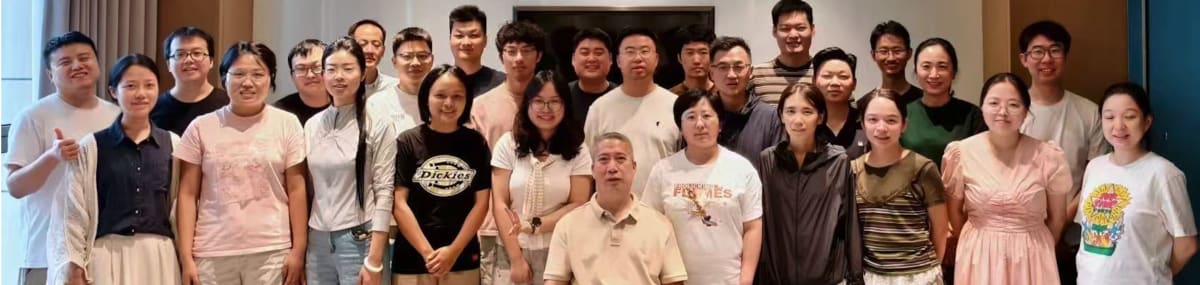
The training lasted three days and brought together about twenty participants. Some had travelled a long way; a few had already taken the course and had come back to learn it again. I found that interesting. People might think that after three days you have “mastered” a technique. But they came back to touch again, compare and ask new questions.
I met this teacher through a colleague’s introduction. What I appreciate is that he stays open to different theories while paying attention to what actually happens in practice. During the training, he took each of our pulses and proposed a Chinese herbal formula according to each person’s situation. Over the following days, we could take the pulse again and observe the changes. Watching how his hands worked, then trying with my own, was a completely different experience from reading a written description.
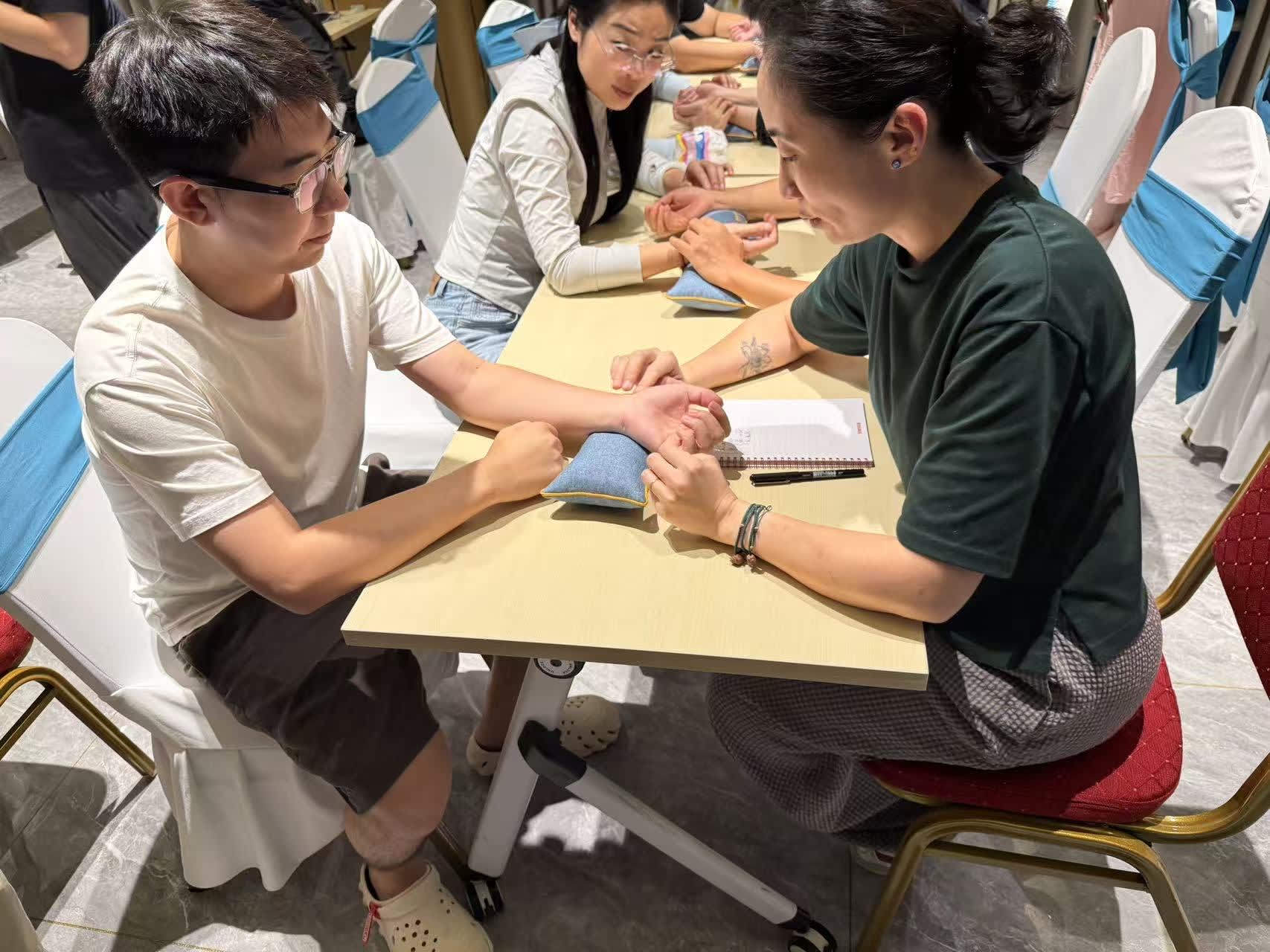
Lijuan tries out the pulse-taking method taught in Nanjing, China
Three positions, three depths
When people hear “taking the pulse”, many picture two fingers on the wrist counting heartbeats. In the Chinese medicine I trained in, it is much more than that. On each wrist, I observe three positions, called cun, guan and chi. At each one, I adjust the pressure of my fingers to feel the superficial, middle and deep levels in turn.
I do not only feel the beat. I also notice the temperature of the hand, how dry or moist it is, and the texture of the tissue around the wrist. Then I try to understand how these pieces of information relate to one another. That second step — interpreting what I feel — is the hardest. Where to place the fingers can be learned; recognising the sensation under them and knowing how to interpret it takes time, comparison and a great deal of practice.
A moment that stayed with me
One moment during the training made a particularly strong impression on me. The teacher had barely placed his hand on one participant’s pulse when he said that the gap between his systolic and diastolic pressure was fairly large, and that he had high blood pressure. Then, in some classmates who had nodules, he was able to pick them up through the pulse.
The correspondence in these two episodes shook me. I write it down to share a personal experience, not to prove that pulse diagnosis could replace a CT scan. Above all, it showed me how finely some people are working to refine pulse reading, and made me realise how much I still have to learn.
Back in France
Since returning to France, I pay closer attention to the differences between pulses. One day, I felt a very superficial change in the pulse of a woman who had come to see me, so I asked whether she had caught a chill. She told me she had indeed caught a cold and had a sore throat.
That is why I now spend a little more time at the start of a session: asking questions, listening to the answers, then cross-checking them with my other observations. The pulse does not replace the person’s own account, nor does it replace medical tests. For me, it adds one more way of observing.
I would also like to understand whether this kind of observation can sometimes help me raise a question worth attention before the person feels any clear discomfort. Chinese medicine expresses this with the saying “the superior physician attends to what is not yet illness” (上医治未病).
Ideas met there, practice adjusted here
This training closely linked pulse diagnosis with Chinese herbal medicine. In China, herbs are usually decocted by machine at the clinic, then divided into sachets for patients to take home. In France, this way of preparing them often does not fit easily into the daily lives of the people I see.
So I discussed concentrated powders with the teacher once again. I had had reservations about them, because manufacturing methods and concentration levels can vary from one supplier to another. He did not reject this form on principle. His answer led me to reconsider using concentrated powders in my own practice, while continuing to watch product quality and whether each formula suits the specific person.
This trip did not give me a finished method; it made my questions more concrete. That is also why I enjoy these trainings: going back to my practice, trying to observe more finely, and telling apart what I have already understood from what I still need to learn.
Want to learn more or book a session?
Book a session